



Wabisabi SushiDerby Review
Tama-GO! GO! GO! These little guys are on a “roll”! (I’m so sorry)

This week had me warming up my cheering voice and primping my pom-poms because July has brought us THE premiere summer sporting event of 2026. I am, of course, talking about Wabisabi SushiDerby, developed by ITAMAE STUDIO. In this training and racing game, you’ll literally mold your inconceivably adorable sushi racers into star athletes. You get to choose from a variety of toppings that each come with their own stats and skills that will help them on the track, and then cheer them on as they face the competition.
Wabisabi SushiDerby puts its charm and sense of humor front and center, and frankly it took no time for me to be won over, as a snarky tanuki fisherman explained the basics of the game. You must champion and train just one sushi racer at a time, first molding them with care from your chosen toppings. All the toppings, seafood, veggies, and more, come from the market, where their price and stats fluctuate based on the season. You can also refer to the bargain toppings, but just remember, you get what you pay for.
Wabisabi SushiDerby in Action


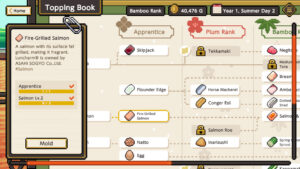

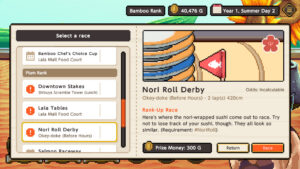
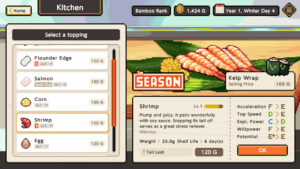


From there, you get to train your eager sushi athlete before each race. First, you get to pick a pack of cards to add to the training regimen, then choose up to three cards from a random assortment. Some of the cards will buff your sushi’s stats, like acceleration, top speed, etc. Other cards teach them a skill, which can either be passive or activated during the race. Getting to customize your training plan offers some fun personalization to the experience, though in general I found that the best strategy was almost always to pick the cards that give the biggest stats boosts (at least when playing at the “Normal” difficulty level).
Once your sushi is freshly assembled and trained up, you get to choose from a variety of different races, depending on how far you’ve progressed through the ranks. Some races are entirely open to any sushi, while others are restricted to certain toppings or by other criteria. I personally loved the concept of the Veteran’s Cup, featuring only sushi rolls that are already several days old. Most of the actual racing is up to your little guy, who you’ve hopefully prepared adequately for the competition, which I actually found very rewarding. It was great to see my choices pay off during the mad dash to complete laps.
Raw talent and raw tuna on display
You do have a couple of ways to support your sushi from the crowd, though. You can cheer them on, which gives them an explosive boost of power, and if they have any non-passive skills, you can choose when to activate them. For me, this was just the right amount of engagement to keep me from tuning out during the races, but still feel relatively chill. There wasn’t any of the heart-pumping adrenaline of a Mario Kart race, and that was exactly what I wanted.
Just like a salmon nigiri, Wabisabi SushiDerby looks simple at first glance, but it is a delicious little bite-sized experience that might just become my gaming comfort food.
Although Wabisabi SushiDerby’s essence is primarily chill vibes and cute-as-heck aesthetics, there is still heartbreak in this game. Like all sushi, your racers have a tragically short shelf life, and you generally only get 3-5 in-game days with your little guys before it’s time to retire them in favor of a fresh roll. There is also the threat of getting eaten on the track, as orders come in regularly from the crowd. You can cheer your sushi on to boost them past the giant swooping chopsticks, but I felt a small gut punch every time my timing was off and I couldn’t save my little guy. Luckily, over time you will level up the toppings you use, so your next generation of sushi racer will get to stand on the (metaphorical) shoulders of the sushi that came before.
Wabisabi SushiDerby Trailer
In every aspect, Wabisabi SushiDerby is an extremely approachable, dare I say “palatable,” experience, making it a great family friendly title. In fact, it took home Bitsummit 2024’s “Kids Award.” Playing at “Normal” difficulty, I didn’t feel I needed any significant amount of skill to eventually win the S1 cup. Choosing the in-season toppings, the highest ranked training cards and spamming the “Cheer” button as often as possible was very often a ticket to success, and I cruised into rolling credits at about 3 hours of playtime. There are higher difficulty levels for players who want to test their sushi-racing strategy.
Even though I conquered the default mode relatively quickly, I can see myself coming back regularly, any time I need a little moment of whimsy. Maybe it’s their rosy cheeks and earnest smiles, maybe it’s the feeling of accomplishment when I see my little sushi breakaway from the pack, I’m not sure, but I feel very attached to these little cuties. Just like a salmon nigiri, Wabisabi SushiDerby looks simple at first glance, but it is a delicious little bite-sized experience that might just become my gaming comfort food.
Get to the point, girl
Emily’s Score: 7.5/10
Emily was provided with a review key of Wabisabi SushiDerby by KanaRey
About No Small Games
No Small Games is an indie game recap and review podcast brought to you by hosts Kate and Emily! They became friends while streaming on Twitch and bonded over their love of indie video games. In each episode of No Small Games, the two will discuss an indie game they both played independently. They’ll compare their experiences: the good, the bad, their most memorable moments of their playthroughs.
Learn more about the podcast and its hosts on the About page.