



Kernel Hearts Review
Let the whole world tremble and quake at the arrival of the Four Girlypops of the Apocalypse.

Simultaneously difficult to grok at first glance, and exactly what it says it is, the Magical Girl action roguelite RPG Kernel Hearts is a bit of an enigma until you dive in. In this debut title from Argentinian studio Ephemera Games and publisher Whitethorn Games, you play as one of four Magical Girl soldiers who embark on expedition after expedition up into the Tower of Babel to fight creatures of biblical proportions in an attempt to save the last remnants of humanity. Obviously. It looks a bit like Genshin Impact, but plays like the love child born of Devil May Cry and Hades. On paper I’m not sure this recipe should work, but my cool two dozen hours of playtime say otherwise, and I have no intention of putting the game down anytime soon.
As a relatively casual fan of action roguelites, I find I enjoy the game loop but fall out of love with each title fairly quickly (with some notable exceptions). I think this is partly due to the genre’s frequent commitment to the “room-based run.” You enter a room filled with baddies, fight for your life to clear it, then move on to the next room and wash, rinse, repeat. After a while it leaves me a little claustrophobic.
Kernel Hearts in Action




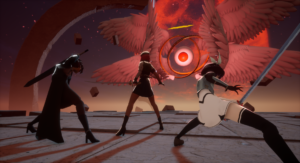
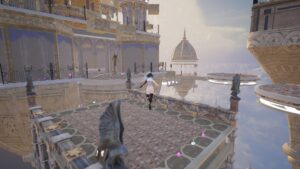


In comparison with a lot of these room-based action roguelites, Kernel Hearts’ open concept level design feels like a breath of fresh air, both literally and figuratively. Each level of the tower is laid out like a large arena, which you’re free to traverse in any order, at any rate that you choose. I felt much less boxed in than I do in a game like Hades or Moonlighter. Plus, players always have the option to abandon any given fight if they bite off more than they can chew. You can’t linger forever, though, as the sin meter (I’m not kidding, that’s really what it’s called) slowly ticks up higher and higher over time, giving you a limited amount of time in which to kick ass and unlock upgrades before the Sky Angel descends and smites you.
An open concept hack-and-slash arena
In my first couple attempts, I got a bit overwhelmed and turned around, which wound up wasting a lot of my precious time. But as I gained more familiarity with the layout of the arenas and the types of upgrades I could unlock by choosing to seek out different encounters, it really clicked with me. I discovered that this level design opens the door for all kinds of player choice that I never realized I was craving in my action roguelites.
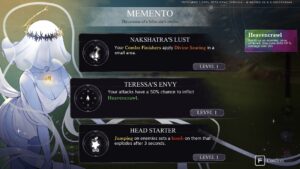
Although the arena levels are randomized upon each entry, they’re populated in predictable and identifiable ways with encounters of various difficulty levels. Players get to decide how big of a fight they want to pick, along with what type of rewards they want to cash in. Do you want to focus on leveling up your stats and magical spells? Or are you looking to gather Mementos, which offer a wide variety of special passive effects? Or will you take your time to hunt for Relics that can grant you everything from stat boosts to extremely rare effects that can completely change how you approach combat?
Many different playstyles are potentially viable in Kernel Hearts, but ultimately efficiency is king. The faster you can hack and slash your way through the angelic hordes, the more upgrades you can unlock before time runs out. This is where I felt the randomization getting in my way, at times, as certain layouts didn’t facilitate finding the kinds of encounters I was looking for. At least not without a lot of time wasted running around. I guess RNG is the real villain of any roguelite, at the end of the day.
Bring on the apocalypse, but make it approachable
For folks who have read up to here, but are new to action roguelites and may still feel on the fence about the gameplay: wow, you must really love Magical Girls, huh? In all seriousness, though, I think this is a really great beginner hack-and-slash and I don’t think new players should feel deterred from picking it up. There are tons of approachability features and settings to get you up and running.
In comparison with a lot of these room-based action roguelites, Kernel Hearts’ open concept level design feels like a breath of fresh air, both literally and figuratively.
I’ll admit that I find combo execution very intimidating in a lot of games, even when the combos are pretty simple and straightforward. One feature of Kernel Hearts that I adored, especially in my first few hours of gameplay, is that the available combos are displayed on the left side of the HUD at all times. They’re small and inconspicuous, but always there if you need them. They even start to highlight as you execute the button inputs, which was great visual feedback that kept me from constantly asking “Am I doing this right?”
I also found the boss battles very approachable, even though some of them also challenged my skills and reflexes quite a bit. Generally speaking, the boss attack patterns felt predictable in a way that I welcomed and specific attacks were telegraphed with just the right amount of time for me to react, while still keeping me on my feet. The game is also generous with its dodge timing, so I could choose to just flit around the stage for a bit if I needed a breather.
My one major complaint about the gameplay was that the meta progression felt very slow-going and a bit limited, especially early on. Most of the meta progression hinges on gathering resources in the tower levels, which are both randomly dispersed and completely irrelevant to everything you need to do to upgrade your build and succeed in the current run. You typically have to gift those resources to different characters, some of whom only appear randomly at some tower levels. Even then, those interactions often just unlock new options that will randomly appear when opening chests or gathering Mementos. The more you succeed in a run, the more resources you inevitably pick up and the process starts to quicken. But for the first few hours, when I was feeling most in need of some permanent upgrades, it felt very slow going.
Ask not whether it makes sense, ask whether it needs to make sense
Finally, we arrive at what you all truly came for: why are these Magical Girls climbing heaven’s staircase, tearing through Cherubim and Seraphim on their way to go kick God’s ass? Well, just like the memories of the traumatized townsfolk who live in the last inhabited human settlement, the answer is hazy. There are a lot of moving pieces in the plot of Kernel Hearts, but they’re delivered in fragments and small vignettes. At least the delivery of the narrative does feel like it belongs to the world of the game: a world in which never-ending ash falling from the sky is slowly wiping away the memories of the few who survived the apocalypse.
Kernel Hearts Trailer
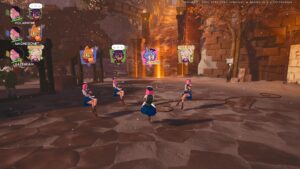
The four playable characters lead with personality, mostly making up for a lack of concrete details surrounding their backstories. They do wind up coming across at times as stereotypical caricatures of the cultures they originate from. This global team includes: Fernet, the plucky and determined Argentinian powerhouse; Spika, the demure but quirky soldier from Japan; Laika, the wry and occasionally crude Russian; and Dolce, the beautiful and sophisticated Italian with Big Diva Energy. Each one has just enough lore to not feel entirely like a cardboard standee, but I found them very charming in their interactions together. In the base camp, you also get the option for one-on-one bonding with each team member, while some cutscenes offer a little window into their (deeply silly and delightful) group dynamics.
To be really honest, the overall vibes and world building are plenty to keep me engaged in the game. The character designs are charming and fun, and the game provides just enough lore drops to make the world feel mysterious and for my mission to feel epic. I’m here for the hack-and-slash gameplay and to feel like a beautiful, badass girlypop, all of which Kernel Hearts serves up on a very approachable platter.
Get to the point, girl
Emily’s Score: 7.5/10
Emily was provided with a review key of Kernel Hearts by Whitethorn Games
About No Small Games
No Small Games is an indie game recap and review podcast brought to you by hosts Kate and Emily! They became friends while streaming on Twitch and bonded over their love of indie video games. In each episode of No Small Games, the two will discuss an indie game they both played independently. They’ll compare their experiences: the good, the bad, their most memorable moments of their playthroughs.
Learn more about the podcast and its hosts on the About page.