



Titanium Court Review
William Shakespeare, Douglas Adams and Oscar Wilde walk into a barcade…

It should be noted up at the top that everything I’m about to say in this review is going to be a little bit wrong. That is because I’m going to try to tell you about Titanium Court, what it feels like to play, and why it will likely be one of my favorite games of 2026. But completely and accurately describing Titanium Court in words alone is impossible. This game is an experience that can only be truly understood by seeing it, hearing it, losing, winning, getting confused, winning some more, failing catastrophically, finally understanding and then becoming utterly flummoxed. So you’ll have to forgive me for the limitations of this written review.
First, let’s travel back to a time, circa 2007, when a teenage girl bearing a very close resemblance to, well, me, was struggling to find her footing, discovering what she liked and who she wanted to be. Young Emily was a weird kid. And no, not like in the “I’m different from the other kids, I’m quirky” kind of way. She was weird in the usual way. Young Emily was both a little too pretentious and a little bit too tacky. She read Nietzsche because she saw Paul Dano doing it in Little Miss Sunshine and listened to CocoRosie because it was the furthest thing from music she could imagine hearing.
Titanium Court in Action
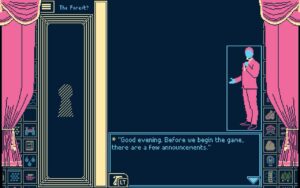
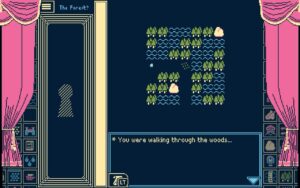
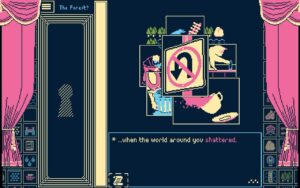
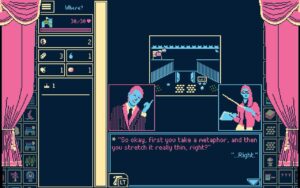
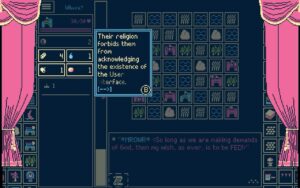
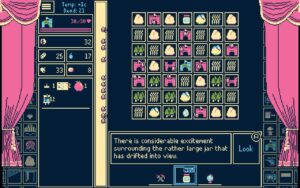
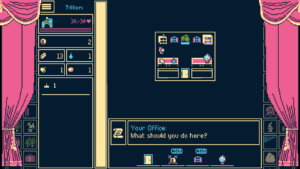
She surrounded herself with as many odd things and ideas and people as she could find because they felt strange and exciting but mostly because, although they didn’t make her feel less weird, they did make her own weirdness feel like less of an existential threat. All of this is context so that when I say Titanium Court made me feel like a teenager again, you know I don’t mean it in the John Cougar Mellencamp’s “Jack and Diane” kind of way.
Fickle faeries and battlefield pickles
Now, let’s fast forward to the year 2026. Titanium Court has just released, from developer A.P. Thompson and renowned narrative indie game publisher Fellow Traveler. The game opens with an Alice in Wonderland-esque hook: you were going about your day, minding your own business, when the entire landscape shifted and transmuted under your feet. The new terrain leads you into the gates of a mysterious court, surrounded by high walls and filled with strange company. You soon learn from your faerie acolyte, known as Puck, that you are in fact the long-absent queen of this magical place (for fans of A Midsummer Night’s Dream, this is when the title Titanium Court will suddenly click into place). What’s more, you are now in charge of waging a fiercely strategic but seemingly fruitless war against the court’s adversaries.
This is when the game itself transforms from a cheeky, theatrical fever dream into a match-three tower-defense roguelite fever dream. Using the same magic that shifted the landscape, bringing you to your bizarre new home, you will match environmental tiles to earn resources and strategically configure the battlefield to your advantage. Once the battle commences, opposing units of immortal faeries emerge from their keeps to attack your stronghold, so you’ll also have to make sure to deploy your own workers, fighters and tactical spells in order to survive each round. On the battlefield you’ll also encounter a variety of helpful, demoralizing, and perplexing structures, such as shops, self defense trainers, tourist-trap-style gift shops, billboards, and your own personal storage unit from back home (where was home, again?).
A.P. Thompson delivers a clever take on the tower defense genre that hooked me immediately and continues serving up additional nuance and strategy along with well-paced plot developments throughout.
A game that’s investing so heavily in surrealist storytelling, extravagantly witty writing and a quirky, minimalist visual aesthetic could easily allow its core gameplay loop to take a backseat. But A.P. Thompson delivers a clever take on the tower defense genre that hooked me immediately and continues serving up additional nuance and strategy along with well-paced plot developments throughout. And although the strategy goes deep, the battle setup phase generally maintains the approachability of a match-three game. Titanium Court falls into my favorite category: games that are easy to pick up and get started, but challenging to excel at.
An attempt to articulate the ineffable
Unfortunately I really can’t tell you anything more about the game’s plot, for a few different reasons. For one, almost anything I could say feels in some way like a spoiler. This game is best experienced completely fresh for the first time, because every moment and conversation feels like a further drawing back of the curtain. There’s an aspect of performance to the experience that makes playing it feel like so much more than the sum of its parts (gameplay, narrative, art direction, etc.).
Second, I can’t say much more about the story because there is a lot about it that I still don’t fully understand myself. Even by the time I got to credits, there were so many questions left unanswered, so many more mysteries to solve, and personal growth to achieve. I have a feeling we will be seeing a lot of comparisons between Titanium Court and Animal Well for this reason. I suspect that even after dozens of hours of playtime, players may still uncover lingering secrets and revelations that could completely overturn our understanding of the plot and its themes.
Titanium Court Trailer
What I can say is that the writing features some of the wittiest and most absurd dialogue you’ll find in a game. My best attempt at describing it is to imagine a world where Douglas Adams and Oscar Wilde got together to produce a play that accidentally came out as a video game. I found myself taking an outrageous number of screenshots, mainly because there were so many clever lines that I didn’t want to forget about. Thankfully, you do eventually unlock a little archive of all the cutscenes you’ve experienced. Thank you, A.P. Thompson, for looking out for us with that one!
To conclude, I must once again reiterate the inaccuracy of this review. All I can offer is my best approximation of the experience of playing Titanium Court, but it really is something that can only truly be understood firsthand. My adventures with Puck and Robin, Hop and the Tooltip Narrator, will live in my mind for a long time to come and I look forward to continuing to explore the depths, breadths, insides and outsides of this game. I honestly hope I never find the end of its mysteries and revelations. I’m also eternally grateful to have found another piece of media that makes weird Young Emily once again feel seen and makes the universe feel a little bit brighter and a lot more bizarre.
Get to the point, girl
Emily’s Score: 9.5/10
Emily was provided with a review key of Titanium Court by Fellow Traveler
About No Small Games
No Small Games is an indie game recap and review podcast brought to you by hosts Kate and Emily! They became friends while streaming on Twitch and bonded over their love of indie video games. In each episode of No Small Games, the two will discuss an indie game they both played independently. They’ll compare their experiences: the good, the bad, their most memorable moments of their playthroughs.
Learn more about the podcast and its hosts on the About page.